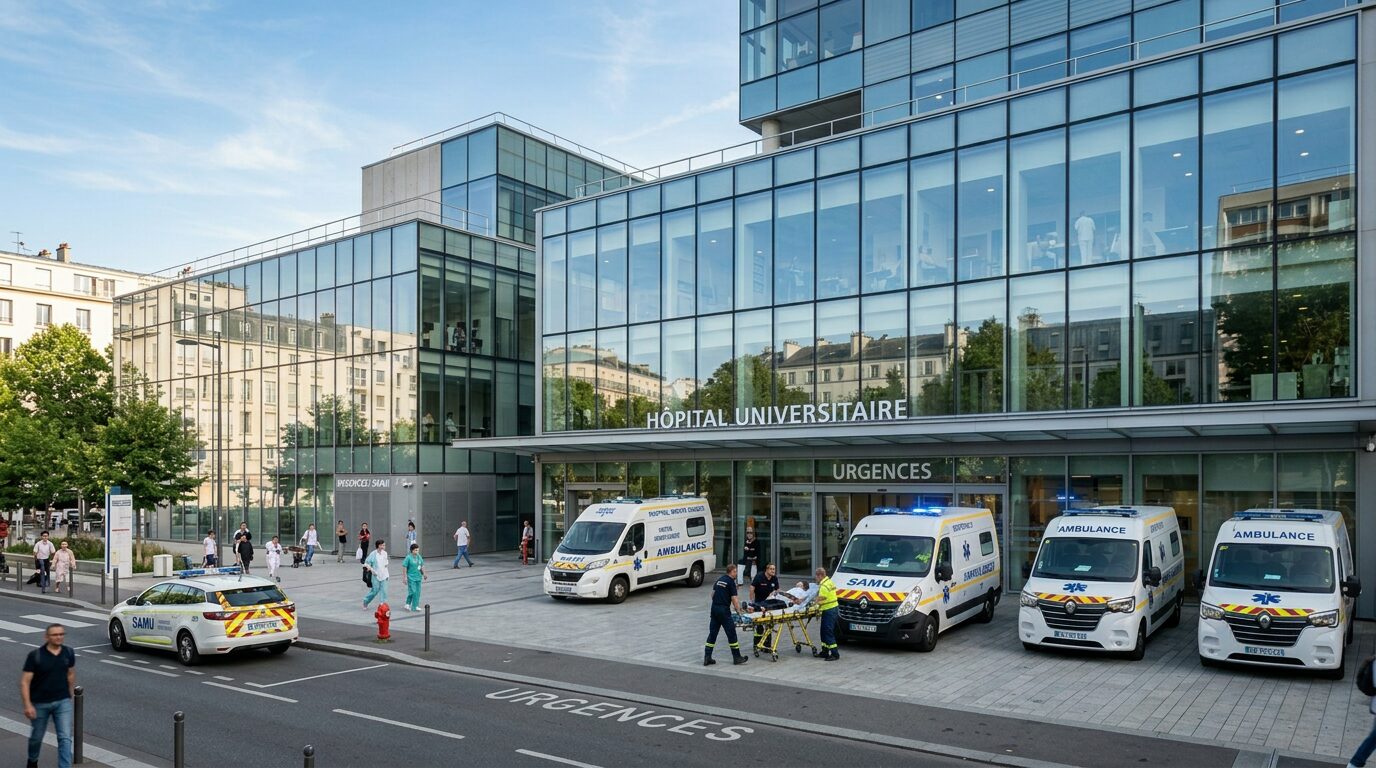
Do High-Performance Buildings Put Emergency Services at Risk?
A Paradox of Modern Construction
Since the early 2000s, European building energy performance standards — governed by the EPBD (Energy Performance of Buildings Directive) — have profoundly transformed the way we design and build. Enhanced insulation, ventilated façades, thermal-break frames, and above all: high-performance glazing.
These glazing units incorporate metallic coatings known as low-e (low emissivity), which reflect infrared radiation to retain heat in winter and keep buildings cool in summer. Buildings become more energy-efficient, more comfortable, more sustainable — an undeniable step forward.
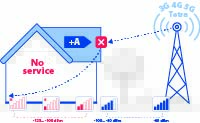
But these same metallic coatings have a side effect that few architects, project owners or contractors anticipate: they significantly attenuate radio signals (including mobile reception). Combined with metal façades — an increasingly prevalent architectural trend in contemporary construction — they can turn a brand-new building into a virtual Faraday cage. Radio signals struggle to penetrate, including the frequencies used by emergency services.
TETRA: The Invisible Network That Protects Emergency Services
Behind every intervention by firefighters, police or emergency medical services, there is a communication network the general public never sees: TETRA (Terrestrial Trunked Radio). It is a secure, encrypted digital radio communication standard designed specifically for public safety services.
Across Europe, this network is operated by dedicated national bodies, including:
- ASTRID in Belgium
- INPT (Infrastructure Nationale Partageable des Transmissions) in France, currently migrating to the RRF (Réseau Radio du Futur)
- ESN (Emergency Services Network) in the United Kingdom
- BDBOS in Germany
- C2000 in the Netherlands
These networks provide dense, robust national coverage. Yet as effective as they are outdoors, they are powerless against a building that physically blocks the signal inside.
A Regulatory Requirement Often Discovered Too Late
In many European countries, buildings open to the public are subject to mandatory indoor radio coverage requirements for emergency services. The principle is straightforward: if firefighters or police cannot communicate reliably inside a building, it cannot receive its certificate of compliance. No compliance, no opening.
The structural problem is that this check typically takes place at the very end of construction, during the final acceptance inspection. By that point, the building is complete, the façades are in place, the glazing is installed. And that is when insufficient signal coverage is discovered.
Traditional solutions exist — signal repeaters or DAS (Distributed Antenna System) — but they involve additional works, several weeks of lead time, significant costs, complex integration into an already finished building, and ongoing maintenance. In an end-of-project emergency, they are rarely viable.
2026: TETRA at a Historic Turning Point
The situation is further complicated by a major technological transformation underway across Europe.
The TETRA network as we know it — referred to as narrowband, operating primarily in the 400 MHz band — is entering the final decade of its exclusive reign. Emergency services have growing needs that narrowband TETRA can no longer meet: real-time location tracking of field teams, video streaming from intervention zones, medical data transmission in ambulances, enriched multi-agency coordination.
The industry and institutional response is called MCX (Mission Critical Services): a set of standards developed by 3GPP that enable critical communications to be carried over commercial 4G and 5G networks, with the same levels of security, priority and resilience as current TETRA. In 2026, several European countries are in active deployment or pilot phases:
- The French RRF is targeting progressive national coverage
- The British ESN is in operational deployment
- The Belgian, Dutch and German networks are actively preparing their migration
This new network will operate in higher frequency bands — around 800 MHz and above — which are even more sensitive to attenuation by modern buildings.
The practical consequence is significant: installing a narrowband TETRA repeater in 2026 means investing in a technology that will be obsolete within two to three years — a costly, complex solution that is already outdated before it has been fully amortised.
Addressing the Problem at Its Source
This is the context in which WAVETHRU technology offers a fundamentally different answer.
Rather than compensating for signal blocking with additional equipment, WAVETHRU addresses the problem at its source: the glazing itself. Using a patented laser treatment, part of the metallic coating is selectively removed from targeted glass panes. These micro-apertures, invisible to the naked eye, allow radio signals to pass through the glass — without affecting the thermal or acoustic performance of the glazing, and without altering its appearance.
The result: the building regains radio transparency across the full spectrum of useful frequencies — from the 400 MHz of today’s TETRA network to the 4G and 5G bands that will carry tomorrow’s critical communications.
WAVETHRU applies equally to new construction — ideally integrated during the finishing phase of the build — and to retrofit projects, on existing buildings where coverage proves insufficient. In both cases: no additional infrastructure, no cabling, no maintenance.
A Solution for Today, Through the Transition, and Beyond
What sets WAVETHRU apart in the context of the migration to broadband critical communications is its technological neutrality: by restoring the physical radio transparency of the glazing, the solution is compatible with all frequencies — those of today and those of tomorrow.
- In 2026: immediate compliance with current TETRA indoor coverage standards
- During the transition: 4G and 5G bands are already improved, ready to carry MCX services
- After migration: no further intervention required — the building is natively compatible with next-generation networks
A building treated with WAVETHRU today will not need to be treated again tomorrow.
See It in Action
This approach has been put to the test in a real-world context, with tight deadline constraints and independent measurements carried out by the national emergency communications operator.
👉 Discover the Jette municipal school case study — Brussels
A Challenge That Will Only Grow
The radio permeability problem in buildings is not an anomaly. It is a structural trend: as EPBD requirements tighten and buildings become more thermally efficient, their envelope becomes increasingly opaque to radio signals. And as critical communications networks move to higher frequencies, the gap between energy performance and radio transparency will continue to widen.
The question is no longer whether this problem exists — it is documented, measured, and subject to regulation. The question is at what stage of the project it is addressed: during the design phase, where solutions are simple and cost-effective, or at the acceptance inspection, where urgency dictates the choices.
Are you designing a new building open to the public? Are you facing a coverage issue in an existing building?


