Modern office buildings and structures face a major paradox. Highly thermally efficient thanks to low-emissivity (low-E) coated glazing, they frequently act as virtual “Faraday cages.” For property managers and occupants, this results in severely degraded indoor mobile coverage, dropped calls, and sluggish data connections.
To solve these signal issues, traditional solutions (such as repeaters or DAS systems) are often cumbersome, complex, and costly. But what if the solution came directly from the building’s envelope, specifically the glazing?
This is the promise of WAVETHRU, the innovative glass developed by AGC to restore radiofrequency transparency. An independent scientific study conducted by IMEC and Ghent University (UGent) now provides unprecedented quantified insights into its benefits, enhancing both connectivity quality and occupant well-being through a drastic reduction in wave exposure.
The Challenge of Modern Glazing Against RF-EMF
Thermal insulation glazing incorporates invisible metallic coatings designed to block heat radiation. Unfortunately, these exact same coatings also block radiofrequency electromagnetic fields (RF-EMF) used by mobile communication networks (2G, 4G, and by extension 5G).
Faced with this significantly weakened indoor cellular signal, an occupant’s smartphone is forced to transmit at maximum power to successfully communicate with the nearest outdoor cellular base station.
What Does the IMEC & UGent Scientific Study Demonstrate?
To measure the real impact of RF-transparent glazing on overall user exposure, IMEC and Ghent University performed rigorous in-situ measurements in an office building in Gosselies, Belgium, comparing spaces equipped with traditional low-E glass versus WAVETHRU treated glass.
The study went beyond simply measuring base station reception power (downlink). It evaluated the total absorbed dose (expressed in mJ/kg) by mathematically combining the downlink (from the base station) and the uplink (the transmission power generated by the user’s mobile device).
3 Key Figures for Decision-Makers
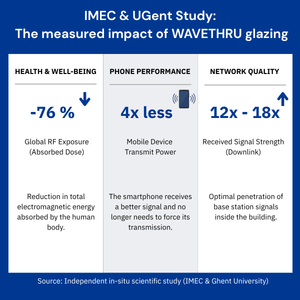
1. A 76% Reduction in Total Exposure (Absorbed Dose): On average across all tested user profiles, WAVETHRU treated glazing reduces the total absorbed electromagnetic energy dose by 76%.
2. A Phone Emitting 4 Times Fewer Waves: Because the signal penetrates the building much more easily (base station received power multiplied by 12 to 18 depending on zones), the mobile device no longer needs to force its transmission. Terminal transmit power is reduced by 36% to 75%.
3. A Clear Improvement in Signal and Data Speeds: The study also demonstrates enhanced indoor network performance: data throughput was on average 4 times higher in offices equipped with WAVETHRU.
A Strategic Asset for Architects, Developers, and Asset Managers
For project owners, real estate developers, or portfolio managers, integrating solutions like WAVETHRU addresses critical challenges:
- Property Valorization: Delivering excellent 4G and 5G indoor reception from the design phase—an increasingly critical requirement for corporate tenants.
- CSR & Well-being Approach: Responding to growing concerns regarding occupational health and the reduction of indoor electromagnetic exposure (precautionary principle).
- Technical Simplicity: Avoiding or reducing reliance on heavy internal signal amplification infrastructures.
Learn More and Download the Study Want to dive deeper into the methodology, measurement equipment, and analyzed user profiles?


